Google Ads vs SEO: Which Wins for Growth?
Google Ads vs SEO: compare speed, cost, lead quality, and long-term ROI so your business can choose the right channel for growth.
A business owner with a slow month usually asks the same question: do we need leads now, or do we need a stronger pipeline six months from now? That is the real issue behind google ads vs seo. Both can grow your business. They just do it on different timelines, with different costs, and with very different operational demands.
If you treat them as interchangeable, you waste budget. If you understand how each channel performs, you can make better decisions, build momentum faster, and stop guessing where your next lead is coming from.
Google Ads vs SEO: The Core Difference
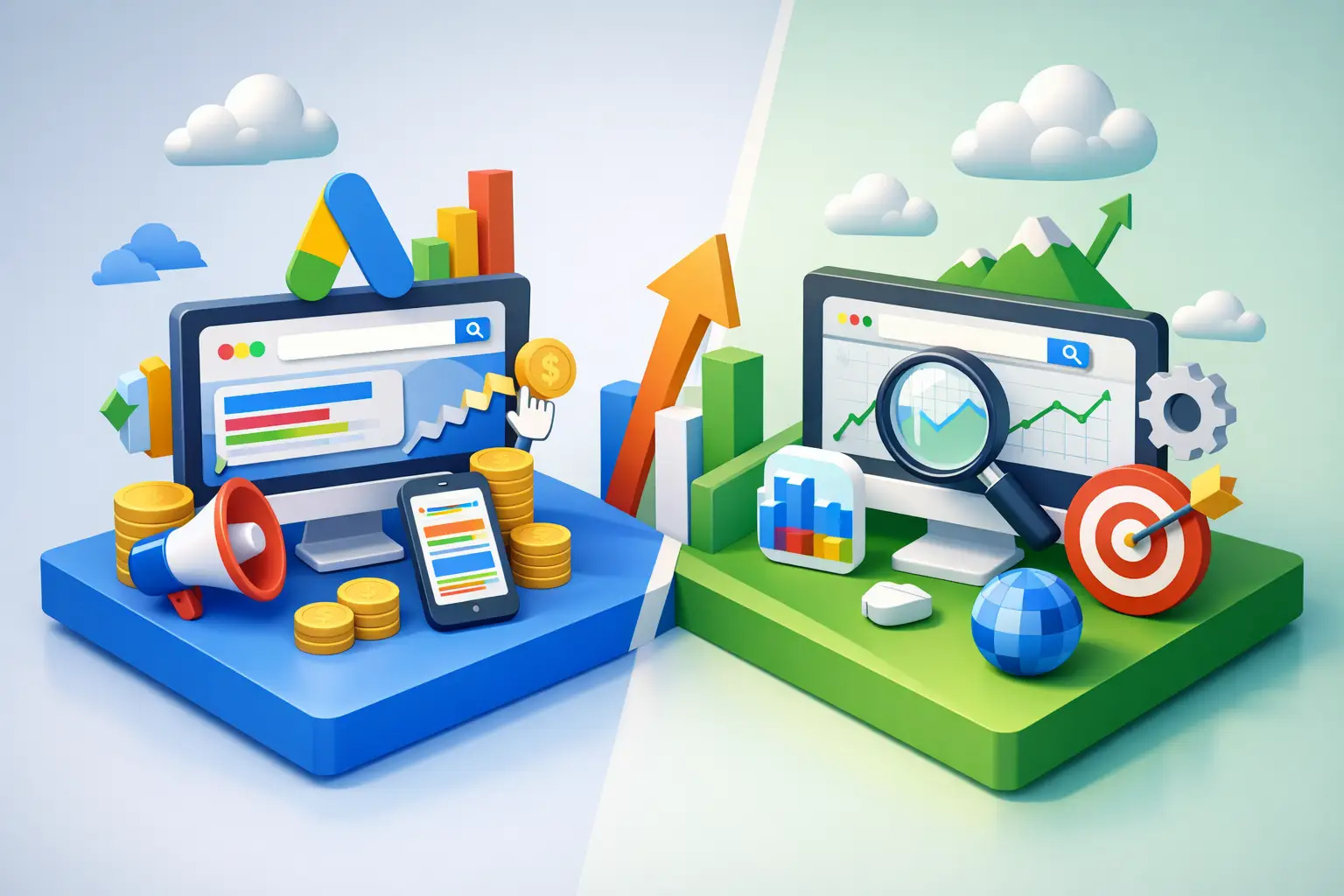
Google Ads buys visibility. SEO earns visibility. That single distinction shapes everything else.
With Google Ads, your business can appear at the top of search results almost immediately. You launch campaigns, target specific keywords, control geography, and start generating clicks as soon as the account is live. It is direct, fast, and measurable.
SEO takes longer. You build pages, improve technical performance, publish relevant content, strengthen site structure, and earn trust with search engines over time. You are not renting placement. You are building an asset that can continue producing traffic without paying for every click.
Neither option is automatically better. The right choice depends on how quickly you need results, how competitive your market is, how strong your website is today, and what kind of growth engine you want to build.
When Google Ads Makes More Sense
If your business needs leads this quarter, Google Ads is often the fastest path. That matters for companies launching a new service, entering a new market, recovering from a revenue dip, or trying to validate an offer before investing in long-term content and optimization.
Paid search also gives you tight control. You can decide which keywords trigger your ads, what message shows up, what landing page users see, and how much you are willing to pay for a click or conversion. That level of control is valuable when you need predictable testing.
For local service businesses, B2B lead generation, and high-intent commercial searches, Google Ads can be a serious revenue driver. Someone searching for a service with clear buying intent is not browsing. They are looking for a solution now.
The trade-off is simple. The moment you stop funding the campaign, the traffic stops. You are paying for access, not building long-term search equity. Costs can also climb quickly in competitive industries, especially if your landing pages and conversion rates are weak.
This is where many businesses get it wrong. They think Google Ads failed, when the real problem was the post-click experience. If your website is outdated, slow, confusing, or poorly structured, paid traffic becomes expensive traffic.
When SEO Is the Smarter Play
SEO makes more sense when you want durable growth and lower dependency on paid acquisition. It is especially effective for businesses with a longer sales cycle, a broad service footprint, or an audience that researches before buying.
A strong SEO strategy lets your company show up across many stages of the buyer journey. You can rank for service terms, local terms, comparison queries, and educational searches that build trust before someone is ready to contact you. Over time, that compounds.
The cost structure is also different. SEO is not free, despite what people like to say. It takes strategy, technical work, content production, UX improvements, and ongoing refinement. But once pages rank, you are not paying for each individual visit. That can create stronger long-term ROI, especially when your content keeps producing qualified traffic month after month.
The downside is patience. SEO usually takes time to gain traction, and competitive markets can take longer. If your site has technical issues, weak content, poor internal structure, or little authority, results do not happen overnight. Businesses that need immediate pipeline relief should not expect SEO alone to solve a short-term lead shortage.
Cost, Speed, and ROI
In the google ads vs seo conversation, these are the three decision points that matter most.
Speed is where Google Ads wins. You can generate impressions, clicks, and leads within days. SEO is slower because rankings have to be earned. If timing is critical, paid search has the advantage.
Cost is more nuanced. Google Ads can become expensive fast, particularly in legal, home services, healthcare, finance, and B2B software. Every click has a price, and not every click converts. SEO requires investment too, but its value tends to compound over time. The better your site performs organically, the less pressure you may have to rely entirely on paid traffic.
ROI depends on execution. A well-run Google Ads campaign with strong landing pages, clean tracking, and focused keyword targeting can outperform SEO in the short term by a wide margin. A strong SEO program can outperform paid search over the long term by producing a steady stream of lower-cost inbound traffic.
That is why the smartest decision is rarely based on channel bias. It is based on your numbers. What is a lead worth? What is your close rate? How long is your sales cycle? What is your customer lifetime value? A channel that looks expensive on the surface can be highly profitable if lead quality is strong.
Lead Quality Is Not the Same Across Both Channels
Not all traffic behaves the same, even when it comes from Google.
Google Ads often captures high-intent users who are ready to act. That can lead to fast conversions, especially for direct-response services. But it can also attract lower-quality clicks if campaigns are too broad, match types are poorly managed, or messaging pulls in the wrong audience.
SEO traffic usually spans a wider intent range. Some visitors are ready to buy. Others are still researching. That can reduce short-term conversion rates, but it also creates more opportunities to build trust and influence future buying decisions.
This is why channel performance should never be judged by traffic alone. More visitors mean nothing if they do not turn into calls, form submissions, booked consultations, or revenue. Real analysis starts after the click.
Your Website Decides More Than the Channel
A lot of businesses debate Google Ads vs SEO before fixing the bigger issue: the website is underperforming.
If your pages load slowly, look dated, lack clear calls to action, or fail to match search intent, both channels suffer. Paid traffic bounces. Organic rankings stall. Conversion rates stay low. Budget gets blamed when the actual problem is infrastructure.
Growth does not come from traffic in isolation. It comes from the full system working together - search visibility, ad strategy, landing page experience, tracking, follow-up, and conversion design. That is why integrated execution matters. The channel brings the visitor in. The site turns attention into business.
For many SMBs, the strongest move is not choosing one channel and ignoring the other. It is improving the website foundation first, then applying the right acquisition mix on top of it.
The Best Strategy for Most Businesses
For most small to mid-sized businesses, the best answer is not Google Ads or SEO. It is Google Ads first, SEO alongside, then a gradual shift toward a more balanced acquisition model.
Use Google Ads when you need immediate demand capture. It gives you speed, data, and market feedback. You can learn which keywords convert, which offers resonate, and which landing pages produce action. That data can sharpen your SEO strategy instead of leaving it based on assumptions.
At the same time, invest in SEO so you are not stuck paying for every lead forever. Build service pages that target buyer intent. Strengthen technical performance. Improve content quality. Tighten site structure. Create a search presence that becomes harder for competitors to displace.
This blended model is where many growth-focused companies gain an edge. Paid search drives short-term pipeline. SEO builds long-term authority. Together, they create more stability than either channel alone.
That is especially true when both efforts are connected to the same business goals, reporting standards, and website strategy. A fragmented approach creates waste. A unified one creates leverage.
So Which One Should You Choose?
Choose Google Ads if you need leads now, want fast testing, and have budget to support ongoing acquisition. Choose SEO if you are building for long-term visibility, want stronger compounding returns, and can stay committed through the ramp-up period.
Choose both if you want to dominate online with a system that performs now and gets stronger over time.
The smartest move is not picking the channel that sounds better in theory. It is picking the one that matches your sales timeline, your margins, your website quality, and your appetite for long-term growth. When those pieces align, search stops being a marketing expense and starts acting like a growth engine.