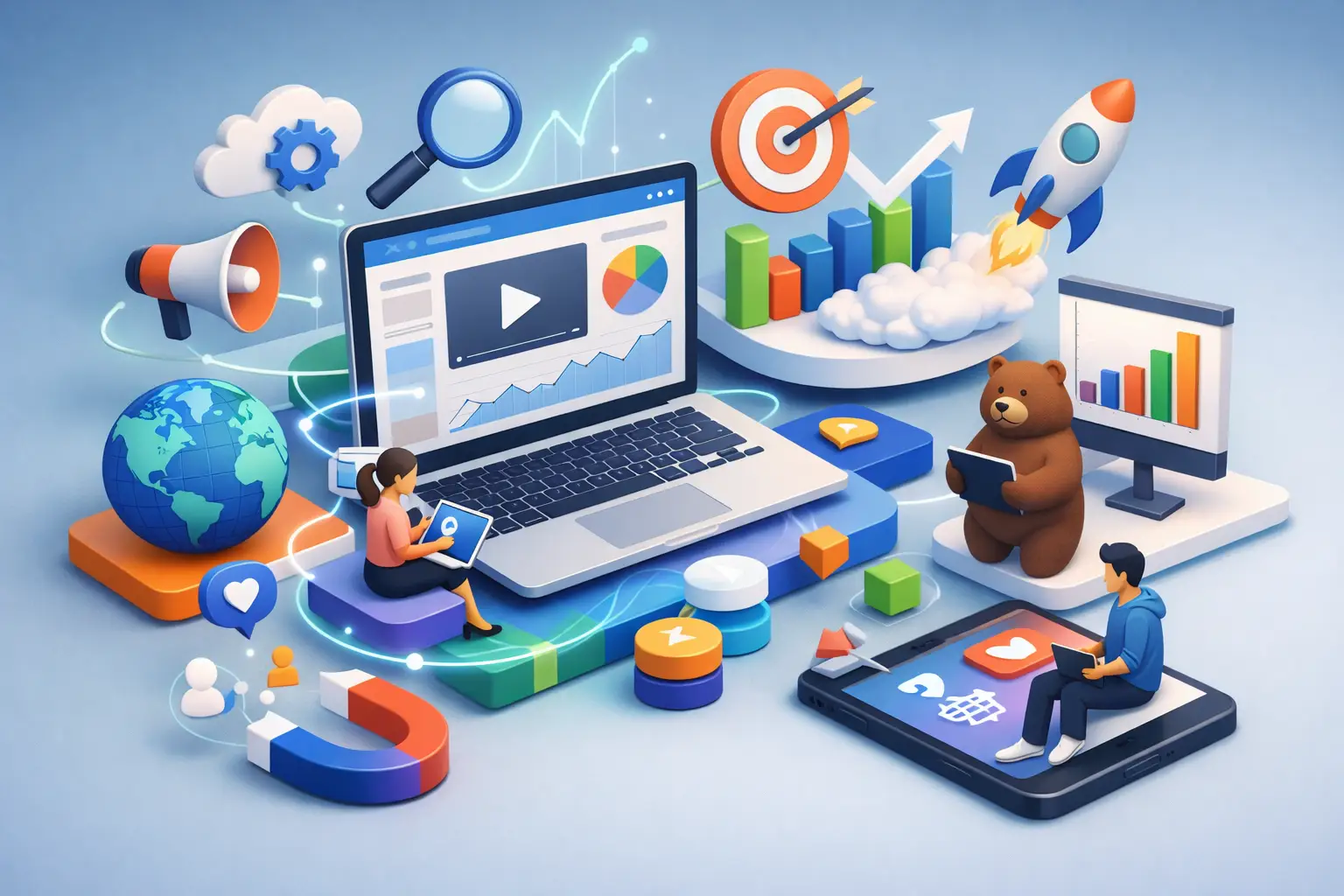
Integrated Digital Marketing Services That Win
Integrated digital marketing services align web, SEO, ads, and data to drive stronger visibility, better leads, and measurable business growth.
When your website, ads, SEO, content, and CRM all move in different directions, growth gets expensive. Integrated digital marketing services solve that problem by turning separate tactics into one connected system built to attract traffic, convert leads, and improve performance over time.
For small to mid-sized businesses, that shift matters. Many companies do not have a traffic problem alone. They have a coordination problem. The site looks fine but does not convert. Ads bring clicks but not qualified leads. SEO improves rankings but the sales team still says lead quality is weak. The issue is rarely one channel by itself. It is the gap between channels.
What integrated digital marketing services actually mean
Integrated digital marketing services bring strategy, execution, data, and technology under one plan. Instead of treating web design, paid advertising, search visibility, email, automation, analytics, and conversion optimization as separate jobs, they are managed as parts of the same revenue engine.
That sounds simple, but the business impact is significant. When one team understands your positioning, target audience, sales process, and performance data across the full funnel, decisions get sharper. Landing pages match ad intent. SEO supports service demand. Automations speed up follow-up. Analytics reveal where leads stall. Every part starts working with context.
This is different from the traditional setup where a business hires one vendor for a website, another for ads, a freelancer for SEO, and someone internal to manage the mess. That model can work, but it often creates duplicated effort, slower execution, and reporting that never tells the full story.
Why disconnected marketing underperforms
Most underperforming marketing programs are not failing because the team lacks effort. They fail because the structure creates friction.
A common example is paid media. A business may invest heavily in Google Ads or paid social and still feel disappointed. The platform may not be the problem. If traffic lands on a slow website, unclear offer, or generic page with weak messaging, ad performance drops fast. Cost per click rises, conversion rate falls, and leadership starts questioning the whole channel.
SEO has the same issue. Ranking for high-volume terms sounds great, but rankings alone do not produce revenue. If your site architecture is weak, service pages are thin, or technical performance is poor, better rankings may still lead to poor lead flow. Search visibility without conversion strategy is just partial progress.
Then there is data. Businesses often look at reports from different tools and still cannot answer basic questions. Which campaigns drive qualified opportunities? Which pages assist conversion? Where do leads drop off? Without integration, reporting becomes noise instead of direction.
The business case for an integrated approach
An integrated model improves efficiency, but the bigger advantage is control. You get a clearer path from attention to conversion.
When strategy is connected, your brand message stays consistent across channels. That consistency builds trust faster. Prospects do not feel like they are meeting a different company every time they move from an ad to a landing page to your website.
You also improve speed. If the same team handles design, development, campaign strategy, and measurement, there is less waiting between ideas and execution. That matters when you need to respond to market changes, test offers, or improve lead quality quickly.
The third advantage is better decision-making. Integrated digital marketing services create a feedback loop. Ad data informs content strategy. Website behavior shapes conversion updates. CRM outcomes influence targeting. Instead of optimizing channels in isolation, you optimize the system.
What should be included in integrated digital marketing services
The exact mix depends on the business, but strong integrated digital marketing services usually center on a few core functions.
Website strategy and development
Your website is not a digital brochure. It is the foundation of your lead generation system. That means performance matters as much as design. Fast load times, clear messaging, strong UX, mobile responsiveness, and clean development all influence conversion.
For growth-focused companies, the technical stack also matters. Modern frameworks and flexible content systems can improve speed, scalability, and long-term control. If your marketing team cannot quickly launch landing pages, test new offers, or connect data sources, the website becomes a bottleneck instead of an asset.
SEO and content alignment
Search visibility is still one of the highest-leverage channels for long-term demand capture. But SEO works best when it is tied directly to service priorities, user intent, and conversion goals.
That means content should not be created just to chase traffic. It should support how buyers search, compare options, and evaluate providers. Technical SEO, on-page optimization, local visibility where relevant, and commercial content all need to work together.
Paid advertising and landing page optimization
Paid media can produce results quickly, but only when the traffic has somewhere effective to go. Integrated teams build campaigns and landing pages together, which gives you tighter message match and cleaner testing.
This reduces waste. It also creates better learning. If a campaign underperforms, you can assess the audience, offer, creative, and page experience together instead of guessing where the problem sits.
CRM, automation, and lead management
Lead generation does not end at form submission. If follow-up is slow, inconsistent, or manual, revenue leaks out after the click.
Automation helps close that gap. Strong integrated marketing includes lead routing, email sequences, CRM workflows, and tracking that connect marketing activity to actual pipeline outcomes. For many businesses, this is where technology makes the biggest difference because it turns interest into a repeatable process.
Analytics and decision support
More data is not the goal. Better decisions are. Integrated reporting should show what is driving visibility, leads, sales conversations, and revenue contribution. If your reports look polished but do not help you choose what to do next, they are not doing their job.
When integrated digital marketing services make the most sense
This approach is especially valuable for businesses dealing with inconsistent lead flow, outdated websites, fragmented vendors, or unclear return on marketing spend.
It is also a strong fit for companies in growth mode. If you are expanding into new markets, launching new services, or trying to outpace competitors, disconnected execution slows you down. A unified model gives you more leverage from each investment.
That said, integration is not always the answer for every stage. A very early-stage business with a limited budget may need to focus on one primary channel first. In those cases, the smarter move may be building a solid website and one acquisition channel before expanding. Integration works best when there is enough activity across channels to benefit from coordination.
How to evaluate a provider
Not every agency offering integrated digital marketing services is truly integrated. Some simply bundle services while keeping teams and strategy disconnected behind the scenes.
Look for a partner that can explain how web, media, SEO, automation, and analytics work together around business goals. Ask how they measure qualified leads, not just traffic. Ask who owns performance across the funnel. Ask how quickly they can implement technical improvements when campaign data reveals a problem.
You also want a team that understands both marketing and technology. That matters more than many businesses realize. Growth today depends on more than creative and media buying. It depends on site speed, data flow, tracking accuracy, automation logic, and the ability to build digital infrastructure that supports scale.
That is where firms with strong development and systems capabilities stand out. A partner like BearSolutions Marketing & Technology can connect marketing execution with modern web development, AI, automation, and data strategy instead of treating those capabilities as separate conversations.
The real payoff
Integrated digital marketing services are not about doing more marketing. They are about making your marketing work together.
That difference changes how businesses grow. Instead of paying for isolated tasks, you build a connected system designed to increase visibility, improve conversion, and create better accountability. The result is usually not just more leads. It is better lead quality, clearer performance insight, and a stronger digital position in the markets that matter.
If your current setup feels busy but not decisive, that is the signal. Growth does not come from stacking tactics. It comes from aligning them. If you want to know what that could look like for your business, request a call and get a clear view of how your website, campaigns, and tech stack can work harder together.