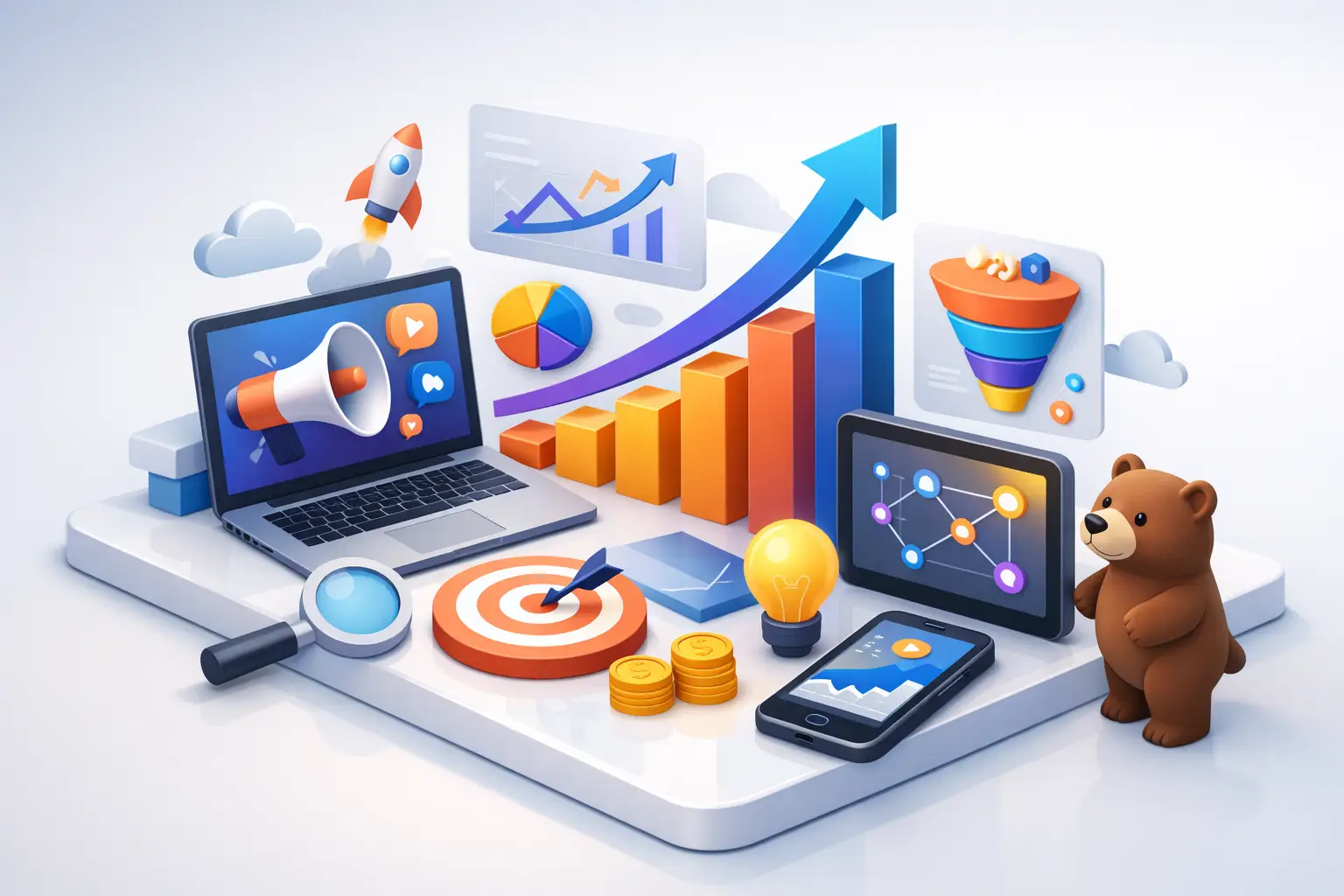
Digital Marketing Strategy That Drives Growth
A digital marketing strategy turns traffic into leads, aligns tech with growth, and helps businesses scale with clearer data and smarter execution.
Most businesses do not have a traffic problem. They have a direction problem. They publish content, run ads, tweak their website, and test new tools, but the pieces do not work together. A strong digital marketing strategy fixes that. It gives every channel a job, every campaign a purpose, and every dollar a path to revenue.
For small to mid-sized businesses, this matters more than ever. You are not competing with whoever is closest to you. You are competing with whoever shows up first, explains their value fastest, and makes the next step easiest. That is why strategy beats activity. More marketing is not the answer. Better alignment is.
What a digital marketing strategy actually does
A digital marketing strategy is the system behind your online growth. It connects your website, content, paid ads, search visibility, email, automation, and reporting into one plan built around business goals.
That sounds obvious, but many companies still treat digital marketing as a set of disconnected tasks. The website is one project. SEO is another. Paid ads live in a separate dashboard. CRM data sits with sales. Reporting happens after the fact. The result is waste. Good channels underperform because the handoff is broken. Bad channels stay alive because nobody can see the full picture.
A real strategy brings those pieces together. It answers a few hard questions upfront. Who are you trying to reach? What action do you want them to take? Which channels fit the buying journey? What technology supports that process? How will performance be measured beyond vanity metrics?
If those questions are not clear, marketing becomes expensive guesswork.
Why most digital marketing strategies fail
The biggest reason is not poor effort. It is poor fit. Businesses often copy tactics from larger brands, chase trends that do not match their buyers, or invest in channels before the foundation is ready.
For example, paid advertising can generate demand quickly, but if the landing page is slow, unclear, or built without conversion in mind, your budget leaks. SEO can produce long-term value, but if your site structure is weak and your content does not target real search intent, rankings stall. Email automation can improve follow-up, but if lead capture is weak, there is nothing meaningful to automate.
This is where a technology-first approach creates an edge. Marketing performance is tied to the systems underneath it. Site speed affects conversion and search visibility. CMS flexibility affects how fast teams can publish and test. CRM integration affects lead quality and follow-up. Attribution affects how confidently you can invest more.
In other words, strategy is not just messaging and media. It is infrastructure.
The core parts of a digital marketing strategy
A practical digital marketing strategy starts with business objectives, not channels. If the goal is lead generation, the plan should be built around attracting the right visitors, converting them efficiently, and moving them through follow-up without delay. If the goal is market expansion, your channel mix and messaging may need to shift toward awareness and education before direct conversion can work.
Your website is usually the center of that system. It is where traffic turns into action. That means design matters, but clarity matters more. Users should know what you do, who it is for, and what they should do next within seconds. Clean UX, strong page structure, mobile performance, and clear calls to action are not cosmetic decisions. They directly affect revenue.
Search visibility is the next major layer. Organic traffic works best when content is mapped to intent. Some pages should capture bottom-of-funnel demand from people ready to buy. Others should support research-stage visitors who need more context before they convert. Both matter. The mistake is treating all content as equal. It is not. Some content builds authority. Some content captures leads. A smart strategy knows the difference.
Paid media adds speed, but it needs discipline. Ads should not be launched just because a platform offers reach. They should be tied to a clear audience, a strong landing experience, and defined economics. If customer acquisition costs rise and close rates stay flat, more spend is not a growth plan. It is a warning sign.
Then there is automation. This is where many growing businesses leave money on the table. Leads come in, but follow-up is inconsistent. Sales gets partial information. Prospects cool off. A strong strategy uses automation to improve timing, routing, qualification, and nurture. That does not replace human selling. It supports it.
How to build a strategy that can actually scale
Start with your numbers. Not surface-level metrics, but the ones tied to business value. Look at where leads come from, how they convert, how long they take to close, and which channels influence real opportunities. If you cannot track that clearly, your first move may not be more marketing. It may be fixing measurement.
Next, audit the buyer journey. Search your own brand. Click your own ads. Fill out your own forms. Read your own service pages. Many companies are surprised by how much friction they have normalized. Confusing navigation, thin content, clunky forms, slow load times, and weak follow-up are common problems. They are also fixable.
Then choose channels based on fit, not popularity. Local service businesses may need a stronger local SEO and Google Ads approach than a heavy social strategy. B2B firms with longer sales cycles may get better results from high-intent content, remarketing, and email sequences than from broad awareness campaigns. There is no prize for using every channel. The win is using the right ones well.
From there, build campaigns around conversion paths. A campaign should not end at the click. It should move the user from interest to action with as little friction as possible. That often means matching ad intent to landing page copy, tightening page messaging, improving page speed, and simplifying form completion. Small changes here can outperform large increases in traffic.
Finally, create a reporting model that helps you make decisions. Too many dashboards answer easy questions instead of useful ones. Impressions and clicks have a place, but they are not enough. You need to know what is driving qualified leads, where the drop-offs happen, and which campaigns deserve more investment.
Strategy works better when design, marketing, and tech are connected
This is where many businesses hit a ceiling. They hire one team for branding, another for web development, another for ads, and another for analytics. Every partner may be capable, but the model creates gaps. Messaging gets diluted. Technical issues slow campaigns down. Reporting becomes fragmented.
An integrated approach solves that. When web development, design, advertising, SEO, automation, and data work together, execution gets faster and smarter. Landing pages can be built for campaign goals instead of generic templates. Analytics can be structured to reflect the actual sales process. Site performance improvements can support both search rankings and paid conversion rates.
That is not a minor operational benefit. It is a competitive advantage.
For businesses serious about growth, the right stack matters too. Flexible modern platforms, faster front-end performance, cleaner data flow, and better automation create room to move faster. You can test more, learn more, and improve without rebuilding the engine every time the market shifts.
What to expect from a strong digital marketing strategy
You should expect focus. Not more random activity. Not vague promises about awareness. A good strategy gives you clearer priorities and better control over where your budget goes.
You should also expect trade-offs. If you want faster lead volume, paid media may play a larger role, but costs can rise without strong conversion systems. If you want lower long-term acquisition costs, SEO and content can pay off, but they take time. If your website needs major improvements, campaign performance may stay capped until that work is done. Strategy means making these decisions intentionally instead of reacting month to month.
Most of all, you should expect momentum. The right plan compounds. Better site performance improves paid results and organic engagement. Better tracking improves budget allocation. Better automation improves close rates. Each layer makes the next one stronger.
If your current marketing feels busy but not decisive, that is the signal. You do not need more disconnected tactics. You need a digital marketing strategy built to turn attention into action and action into growth. If you want a partner that can connect the marketing, website, data, and technology behind that growth, BearSolutions can help you map the system and build it right. The businesses that win online are rarely the loudest. They are the ones with the clearest plan and the discipline to execute it.