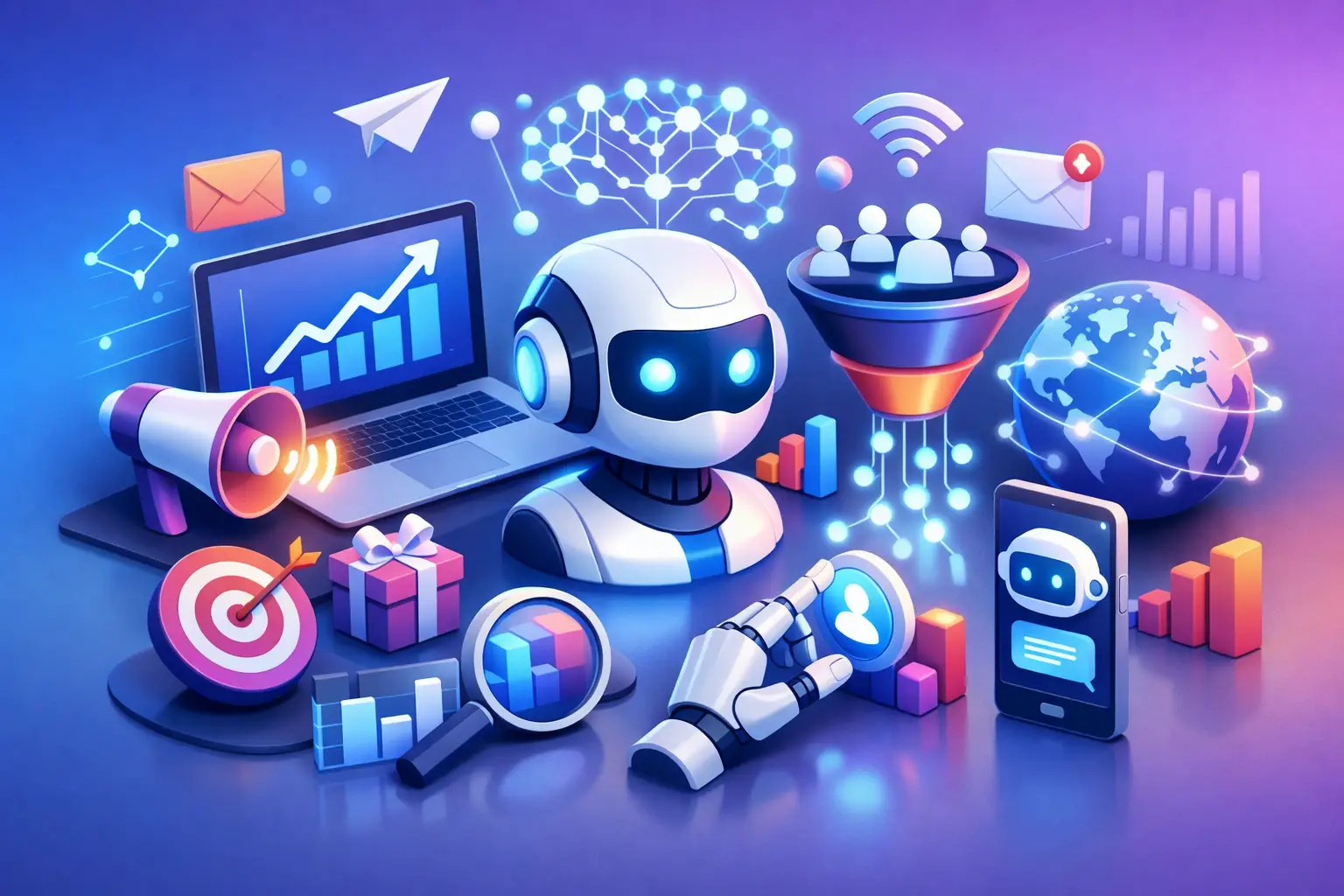
7 AI Marketing Automation Trends to Watch
See the ai marketing automation trends shaping lead generation, ad performance, and customer journeys for growth-focused businesses in 2026.
If your marketing team is still stitching together reports, writing every email by hand, and reacting to campaign performance days late, you're already losing ground. The biggest ai marketing automation trends are not about replacing strategy. They are about helping businesses move faster, target better, and turn more traffic into revenue without adding chaos to the tech stack.
For small to mid-sized businesses, that matters. Most teams do not have extra headcount to waste. They need marketing systems that reduce manual work, improve decision-making, and support real growth. The companies that win with AI will not be the ones using the most tools. They will be the ones using the right automation in the right places.
Why ai marketing automation trends matter now
AI in marketing is shifting from experiment to operating model. A year ago, many businesses were using AI for one-off content tasks or basic chatbot support. Now the conversation is different. Leaders want AI tied to lead quality, conversion rates, campaign efficiency, and customer retention.
That shift is healthy. Automation on its own is not a competitive edge. Automating bad processes only makes bad results happen faster. What matters now is whether AI can improve how your funnel works, how quickly your team responds, and how accurately you allocate budget.
The trade-off is that more automation creates more dependence on data quality, platform integration, and clear rules. If your CRM is messy, your conversion tracking is incomplete, or your website experience is weak, AI will expose those problems quickly.
1. Predictive targeting is replacing broad audience guessing
One of the strongest ai marketing automation trends is the move away from static audience segments toward predictive targeting. Instead of building campaigns around surface-level demographics, businesses are using AI to identify intent signals, engagement patterns, and likely conversion behavior.
This changes how paid media and lead generation work. Rather than asking who your customer is in theory, predictive models look at what real prospects are doing across channels. That leads to sharper audience selection, better retargeting windows, and more efficient ad spend.
For businesses with limited budgets, this is a major advantage. You do not need more impressions. You need better ones. The catch is that predictive targeting performs best when your tracking is clean and your campaigns have enough historical data to learn from.
2. AI is becoming the engine behind real-time campaign optimization
Manual optimization is too slow for modern campaign cycles. Teams that review performance once a week are often reacting after the best opportunity has passed. AI is now being used to adjust bids, pacing, creative rotation, and audience allocation in closer to real time.
This is one of the ai marketing automation trends with immediate commercial value because it impacts spend efficiency directly. If one ad set starts producing lower-cost qualified leads, the system can shift budget faster. If a landing page underperforms with mobile traffic, the issue becomes visible sooner.
That said, full automation is not always the answer. Real-time optimization works best when paired with human oversight. AI can spot patterns quickly, but it still needs strategic guardrails. Otherwise, it may optimize for cheap conversions that do not turn into revenue.
3. Personalized customer journeys are getting more practical
Personalization used to mean adding a first name to an email. Now it means adapting content, timing, offers, and follow-up based on behavior. Businesses are using AI to trigger different journeys depending on page visits, form activity, purchase history, ad engagement, and CRM stage.
This matters because generic marketing is expensive. If every lead gets the same message regardless of intent, your nurture flow becomes noise. AI-driven automation makes it easier to deliver a more relevant experience without building dozens of manual workflows.
The practical win is stronger follow-up at scale. A prospect who visits a pricing page twice should not receive the same sequence as someone who downloaded a top-of-funnel guide. Better journey design improves conversion rates and shortens response time.
The risk is overcomplication. Many businesses create too many branches too early. A simpler journey with strong segmentation often outperforms a complex system nobody maintains.
4. AI-generated content is moving from volume to performance
There is no shortage of AI-generated content. The real question is whether it performs. One of the most important ai marketing automation trends is the shift from producing more assets to producing assets tied to measurable outcomes.
That includes ad copy variations, email subject lines, landing page headlines, product descriptions, and sales enablement content. AI can accelerate testing and shorten production cycles, which is valuable for teams trying to launch faster or support multiple campaigns at once.
But speed is not enough. Thin messaging will not fix a weak offer, and generic copy will not build trust with serious buyers. The businesses getting results are using AI to generate options, then applying human review, brand judgment, and conversion insight before publishing.
For B2B brands especially, this balance matters. You want automation to reduce production bottlenecks, not flatten your positioning until you sound like everyone else.
5. Conversational AI is becoming a lead qualification tool
Chatbots have been around for years, but they often felt scripted and shallow. That is changing. More businesses are now using conversational AI to handle first-touch engagement, answer high-intent questions, and route leads based on fit.
Done well, this improves speed and lead quality at the same time. A visitor can ask about pricing, services, timeline, or availability and get immediate direction instead of waiting for a reply. That is especially valuable when traffic comes from paid campaigns, where response lag can waste acquisition spend.
The difference now is that conversational AI can connect more deeply with CRM, scheduling, and workflow systems. It is not just answering questions. It is helping move prospects into the next stage.
Still, there is a line. If the interaction feels evasive or overly automated, trust drops fast. Businesses should use conversational AI to remove friction, not to hide from real conversations.
6. Unified data is becoming the foundation for better automation
A lot of marketing automation fails for one simple reason: the data is fragmented. Website analytics live in one place, ad data in another, CRM records somewhere else, and no one fully trusts the reporting. AI cannot fix that by itself.
That is why one of the less flashy but more valuable trends is the push toward connected systems. Businesses are investing in cleaner integrations between websites, forms, ad platforms, CRMs, and reporting dashboards so automation has reliable inputs.
This is where the technology side of marketing starts to matter more. If your website, lead capture flow, and backend systems are disconnected, automation will stay limited. If they are connected properly, AI can trigger actions based on meaningful signals instead of guesswork.
For many companies, this is the real competitive gap. Not content generation. Not trendy tools. Infrastructure.
7. AI scoring is improving how sales and marketing work together
Marketing teams often celebrate lead volume while sales teams complain about quality. AI-based lead scoring is helping close that gap by ranking prospects based on conversion likelihood, engagement depth, and behavioral fit.
This creates better prioritization. Sales can spend more time on leads showing real buying intent, while marketing can build smarter nurture paths for early-stage prospects. It also helps leadership see which channels are generating pipeline instead of just form fills.
Like every trend on this list, results depend on setup. If the scoring model uses weak signals or the handoff process is unclear, the output will disappoint. But when the model is tied to actual sales outcomes, the impact is significant.
What businesses should do next
The smartest move is not adopting every new tool. It is identifying where automation can create the clearest business gain right now. For one company, that may be ad optimization. For another, it may be lead routing, CRM follow-up, or website personalization.
Start with the bottlenecks. Look at where leads slow down, where manual work piles up, and where budget gets wasted. Then assess whether your data, website, and core platforms are ready to support AI effectively. If they are not, fix the foundation first.
That is the difference between using AI as a gimmick and using it as an advantage. BearSolutions Marketing & Technology sees this firsthand: the businesses that grow fastest are the ones that connect strategy, technology, and execution into one system built for performance.
AI will keep changing how marketing gets done. The real opportunity is not chasing every trend. It is building a smarter operation that helps your business respond faster, market better, and compete with more precision.