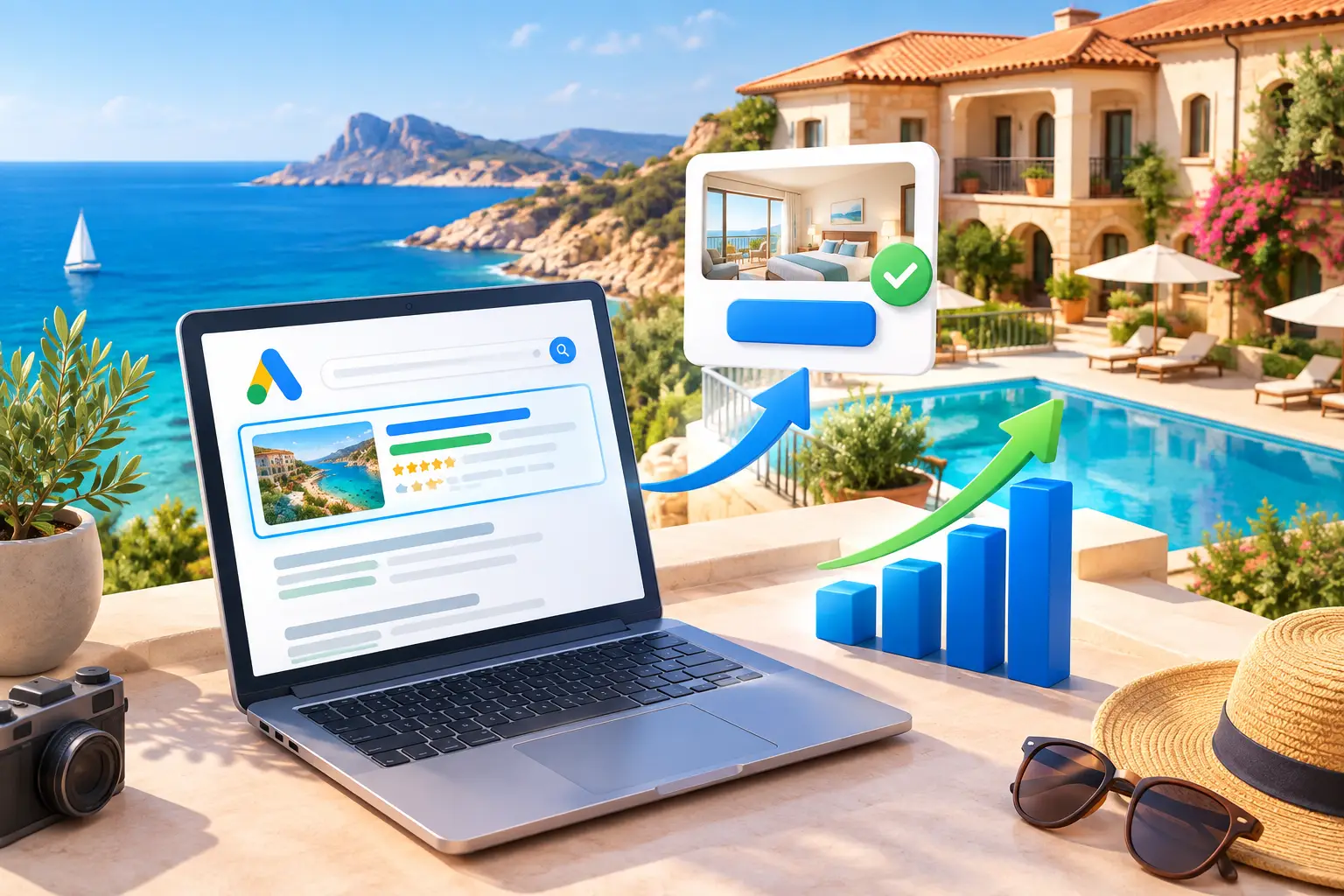
How We Helped a Sardinian Hotel Get Booked via Google Ads
See how we helped a Sardinian hotel get booked via Google Ads using smarter targeting, landing pages, tracking, and a conversion-first campaign setup.
A beautiful hotel does not automatically win bookings. It still has to appear at the exact moment a traveler is comparing options, checking dates, and deciding where to stay. That is how we helped a Sardinian hotel get booked via Google Ads: by treating paid search as a revenue channel, not a visibility exercise.
The goal was straightforward. Put the hotel in front of high-intent travelers, make the booking path easier to trust, and use real conversion data to improve every decision. For independent hotels, that combination matters. Competing with major travel platforms and large hospitality brands takes more than a few broad ads and a modest daily budget.
The challenge: demand existed, but direct bookings needed focus
Sardinia already attracts travelers looking for beaches, food, culture, and a more distinctive Italian escape. But destination demand is only one part of the equation. A guest searching for a hotel has dozens of options, from boutique properties to large resorts and online travel agencies with massive ad budgets.
The hotel needed a campaign that could capture demand without wasting spend on searches that looked relevant but had little chance of becoming a booking. Terms such as "Sardinia vacation" can generate traffic, for example, but they often include people researching flights, itineraries, or places to visit months before they are ready to reserve a room.
The commercial question was not, "How do we get more clicks?" It was, "How do we generate more qualified booking opportunities at a cost that makes sense for the property?"
That distinction shaped the entire account structure.
How we helped a Sardinian hotel get booked via Google Ads
We built the campaign around intent. Search campaigns were organized to reflect the language people use when they are close to choosing a stay: hotel searches tied to the area, accommodation searches with specific travel needs, and branded searches from people already familiar with the property.
This approach gave us control. Rather than placing every relevant keyword in one campaign and hoping Google's automation would find the right audience, we separated search themes so budget, messaging, and performance could be evaluated clearly.
A traveler looking for a boutique stay, a beach-adjacent hotel, or accommodation for a particular season is not necessarily responding to the same message. The ads needed to match the search as closely as possible while remaining honest about what the hotel offered.
Search terms were filtered with commercial intent in mind
Keyword research is not a one-time task. Once a campaign is live, the actual search query data reveals where budget is going and where it should not go.
We reviewed those patterns to identify irrelevant searches, low-value information queries, and traffic that did not fit the hotel’s offering. Negative keywords helped protect the budget from terms related to jobs, long-term rentals, unrelated locations, and other searches that would not lead to a reservation.
This is one of the least glamorous parts of Google Ads management, but it is where a campaign becomes more efficient. Every dollar spent on the wrong visitor is a dollar unavailable for a traveler ready to book.
The ads sold the decision, not just the room
A hotel ad has limited space. It cannot tell the entire story of a destination, the property, and the guest experience. It has to earn the next click.
The copy focused on clear reasons to consider booking direct: the character of the stay, location-driven relevance, availability cues where appropriate, and a direct route to the hotel website. We used multiple variations so the account could test which messages earned stronger engagement from the right searches.
The goal was never to write clever copy for its own sake. It was to create a strong match between the traveler’s need, the ad promise, and the page they saw next.
The landing experience had to carry its share of the work
Paid traffic is expensive when the website makes visitors work too hard. A traveler who clicks an ad and lands on a slow, confusing, or generic page is likely to return to the search results and book somewhere else.
For this reason, the website experience was part of the advertising strategy. The landing path needed to make essential information easy to find: what made the hotel worth considering, where it was located, how to check availability, and how to complete a reservation without friction.
Mobile mattered especially. Many travelers research and compare accommodation from their phones, often while moving between maps, review platforms, airline sites, and messaging apps. A mobile booking journey cannot feel like an afterthought.
The right solution depends on the hotel’s existing stack. Sometimes a focused campaign page is the best answer. In other cases, improving the booking path on the main website creates the better long-term asset. The point is not to force every hotel into the same funnel. The point is to remove the barriers standing between intent and action.
Tracking turned spend into usable intelligence
Without accurate conversion tracking, Google Ads optimization becomes guesswork. Click-through rate may look encouraging, but it does not tell you whether visitors checked dates, started a reservation, contacted the hotel, or completed a booking.
We focused on the actions that signaled genuine commercial value. Depending on the booking engine and available data, this can include completed reservations, booking-engine handoffs, availability checks, phone calls, or qualified inquiry forms.
The quality of tracking determines the quality of optimization. If the platform is fed weak signals, it will learn from weak signals. If it receives meaningful conversion data, bidding decisions and budget allocation can improve over time.
For a hotel, this also creates a clearer conversation around return on ad spend. Not every booking has the same value. Seasonality, stay length, room type, and booking window all influence the economics. A campaign should be judged against profitable demand, not vanity metrics.
Budget was managed around opportunity, not ego
A common mistake is spreading a limited hotel advertising budget across too many campaign types, audiences, and locations before search performance is proven. That makes it difficult to see what is actually working.
We prioritized the channels and search themes most likely to capture active demand. As performance data accumulated, budget could be shifted toward terms, devices, locations, and time periods producing stronger booking signals.
There is no universal daily budget that works for every property. A small independent hotel in a highly seasonal market needs a different plan than a year-round resort. Competition also changes by month, event calendar, geography, and traveler origin.
The smart move is to begin with enough budget to gather meaningful data, then scale where the numbers support it. Spending more does not automatically create more profitable bookings. Spending with control does.
What this approach means for growing hospitality businesses
The campaign demonstrated a principle that applies far beyond one hotel in Sardinia: paid media performs best when advertising, website experience, and data work as one system.
If your ads are strong but your booking path is weak, conversion suffers. If your site looks great but nobody can find it when intent is high, demand leaks to competitors. If tracking is unreliable, your team cannot confidently decide what to scale, pause, or fix.
That is why BearSolutions Marketing & Technology approaches Google Ads as part of the wider growth engine. Campaign strategy, landing-page performance, analytics, automation, and the underlying tech stack should support the same commercial outcome: more qualified customers taking action.
For hotels, service businesses, and ambitious companies competing for attention online, the opportunity is not simply to run ads. It is to build a system that makes every paid visit more valuable.
If you want to know what a focused Google Ads setup would look like for your business, what it should track, or what budget makes sense for your market, request a call with BearSolutions. The best campaigns start with a clear view of where revenue is being won or lost.