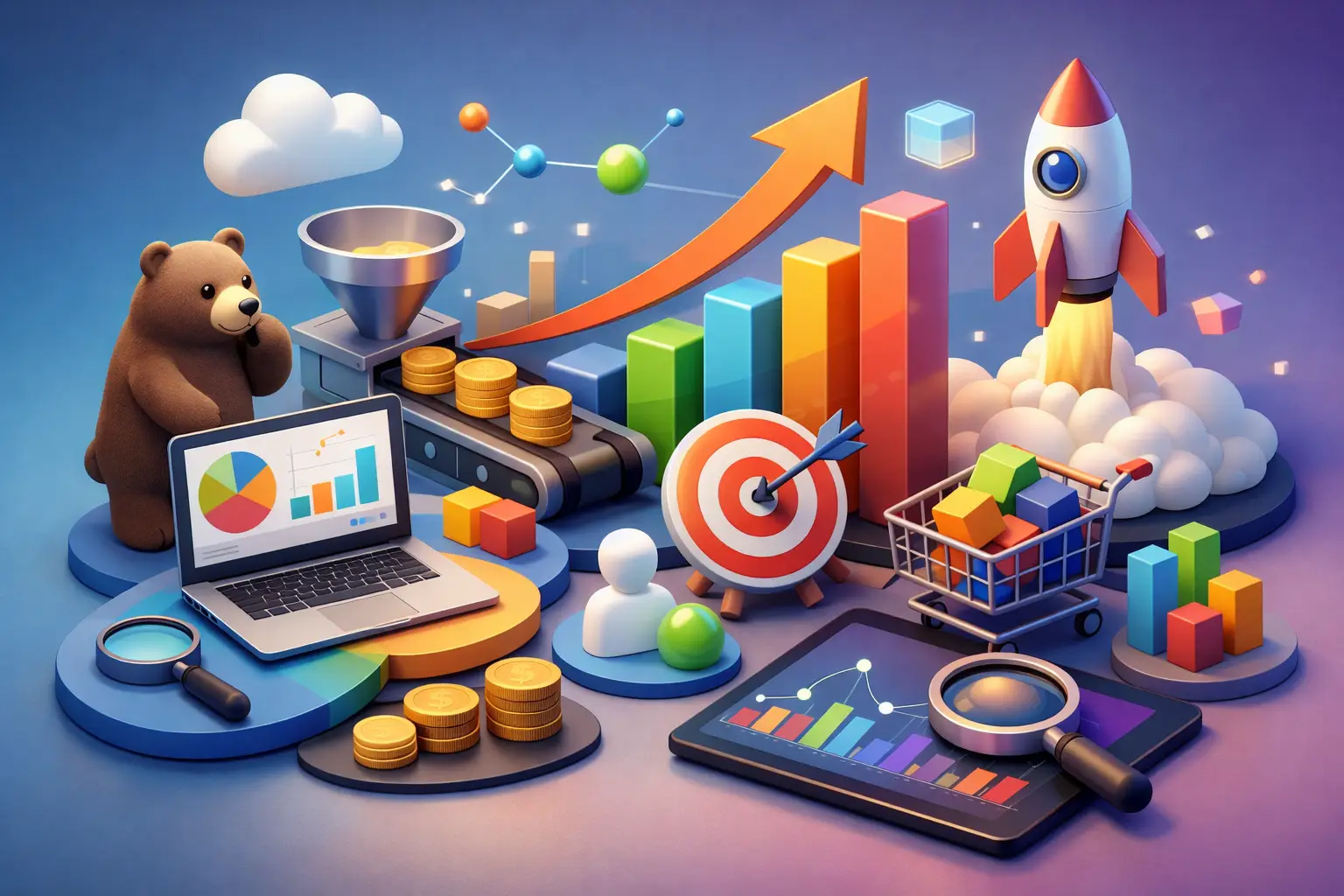
Data Science That Turns Marketing Into Growth
Data science turns scattered customer, website, and campaign signals into decisions that improve lead quality, spend, and measurable business growth today.
A website can attract thousands of visitors and still fail to produce meaningful revenue. Paid campaigns can generate clicks while sales teams chase leads that never buy. The problem is rarely a lack of activity. It is a lack of clarity. Data science gives businesses a practical way to turn website behavior, campaign performance, customer records, and sales outcomes into better decisions.
For small and mid-sized businesses, this is not about building a Silicon Valley research lab. It is about knowing which channels create profitable demand, which audiences are most likely to convert, where prospects drop off, and what action will produce the strongest return.
What Data Science Means for Business Growth
Data science combines data analysis, statistics, automation, and machine learning to find useful patterns in information. In a growth-focused business, its job is straightforward: replace assumptions with evidence and turn evidence into action.
That action may be reallocating ad spend toward higher-value leads, improving a website page that causes abandonment, identifying customers ready for a follow-up, or forecasting demand before a busy season. The technology matters, but the commercial result matters more.
A business does not need millions of rows of data before this work becomes valuable. Even a modest volume of website traffic, form submissions, CRM records, call data, invoices, and ad results can reveal costly gaps. The key is connecting those sources so performance is measured from first click through closed revenue, not just by surface-level metrics such as impressions or likes.
Why Marketing Metrics Alone Are Not Enough
Most marketing platforms report their own version of success. An ad platform may report conversions. Analytics software may show website sessions. A CRM may show pipeline opportunities. Each system can be useful on its own, but none tells the full story when it operates in isolation.
Consider a local service company running search ads and social campaigns. One channel may produce cheaper form fills, while another produces fewer leads at a higher initial cost. If the cheaper leads rarely answer calls or have low project budgets, they are not truly cheaper. Data science connects marketing results with sales outcomes, helping the business evaluate cost per qualified lead, cost per opportunity, close rate, customer value, and return on ad spend.
This changes the question from, “Which campaign got the most leads?” to, “Which campaign created the most profitable customers?” That is the question that protects budget and drives growth.
The Data That Creates a Clearer Picture
The strongest insights come from combining data that describes the full customer journey. Website data shows how people arrive, what pages they view, how long they engage, and where they leave. Campaign data shows which ads, audiences, keywords, and offers created that traffic. CRM and sales data show whether those prospects were qualified, contacted, quoted, and won.
Customer data adds another layer. Repeat purchases, service history, average order value, location, and referral source can reveal where the best opportunities live. A company may learn that its highest-value customers share a specific industry, geography, service need, or first interaction with the brand.
There is a trade-off here. More data is not automatically better. Collecting everything without a defined business question creates noise, privacy risk, and dashboards nobody uses. Start with the decisions that affect revenue: where to invest budget, what audiences to target, which pages to improve, and which leads deserve immediate attention.
How Data Science Improves Digital Marketing
Better lead scoring
Not every inquiry deserves the same response. A lead-scoring model can rank prospects based on signals such as source, company size, requested service, pages visited, form answers, location, and prior engagement. Sales teams can prioritize the people most likely to become customers rather than working a first-come, first-served queue.
For businesses with limited sales capacity, this can be a major advantage. Faster follow-up on high-intent leads often improves conversion without increasing ad spend.
Smarter campaign optimization
Campaign optimization is often reactive. A marketer sees a high cost per lead and pauses an ad. But data science can go further by assessing lead quality over time, detecting patterns across campaigns, and identifying combinations of audiences, messages, and landing pages that produce revenue.
It also helps avoid a common mistake: cutting a campaign too early. Some channels influence buyers who convert later through branded search, direct traffic, or a sales conversation. Attribution is not perfect, especially for longer B2B buying cycles, but connected data provides a much more credible view than platform reporting alone.
Websites that convert with intent
A website should not be a digital brochure. It should be a measurable sales asset. Data can show whether visitors understand the offer, where mobile users struggle, which service pages attract qualified traffic, and which calls to action create serious inquiries.
The answer is not always a full redesign. Sometimes a stronger headline, clearer proof, faster page load, simplified form, or more relevant landing page has the biggest impact. The right improvement depends on the evidence, not design preference.
Forecasting and retention
Data science can also help businesses look ahead. Historical sales, seasonal demand, lead volume, and customer behavior can support forecasts for staffing, inventory, budget, and pipeline planning. For recurring or repeat-purchase businesses, it can flag customers who may be at risk of leaving and identify the right moment for retention outreach.
Forecasts are estimates, not guarantees. Economic shifts, new competitors, pricing changes, and changes in tracking can affect accuracy. Still, a grounded forecast is far more useful than planning based only on instinct.
Build the Foundation Before Chasing AI
AI tools are powerful, but they cannot repair disconnected systems or unreliable tracking. If a CRM contains duplicate records, form submissions are not routed correctly, phone calls are not tracked, and website events are poorly configured, automated recommendations will inherit those weaknesses.
The foundation starts with clean definitions. Decide what counts as a qualified lead, a sales opportunity, a closed customer, and a successful campaign. Make sure those definitions are used consistently across marketing and sales. Then connect the systems that hold the essential data and create reporting that decision-makers can understand quickly.
This work often requires collaboration between marketing, sales, operations, and technology teams. That can feel slower than launching another campaign, but it prevents expensive decisions based on incomplete information. A polished dashboard with bad inputs is still a bad decision tool.
A Practical Starting Point for Data Science
Start with one business problem that has a clear financial impact. For example, a company may need to reduce wasted ad spend, increase booked appointments, improve lead response time, or identify why traffic is not converting. Define the current baseline, identify the data sources, and determine what result would make the initiative worthwhile.
Next, ensure tracking captures the actions that matter. That may include calls, form submissions, booked meetings, quote requests, purchases, and qualified pipeline stages. Website events should connect to the CRM wherever possible, so the business can see what happens after a prospect converts.
Then test improvements in controlled increments. Change a landing page, audience, offer, lead-routing rule, or follow-up sequence and measure the outcome. Data science should create a cycle of learning and improvement, not a one-time reporting project.
Turn Your Data Into a Competitive Advantage
Businesses that treat data as an afterthought often keep spending more to solve problems that better visibility would expose. They chase vanity metrics, rely on disconnected vendors, and struggle to explain why marketing performance changes from month to month.
Businesses that connect their marketing, website, sales, and customer data gain a different advantage. They can move budget with confidence, respond to high-value prospects faster, and build digital systems that improve over time.
BearSolutions Marketing & Technology helps businesses bring strategy, digital execution, automation, and data into one growth-focused operation. If your marketing reports do not clearly show what is creating revenue, request a call and build a measurement strategy that gives your next decision real direction.
The best next step is not collecting more numbers. It is choosing one revenue-critical question your business cannot answer today, then building the data path to answer it.