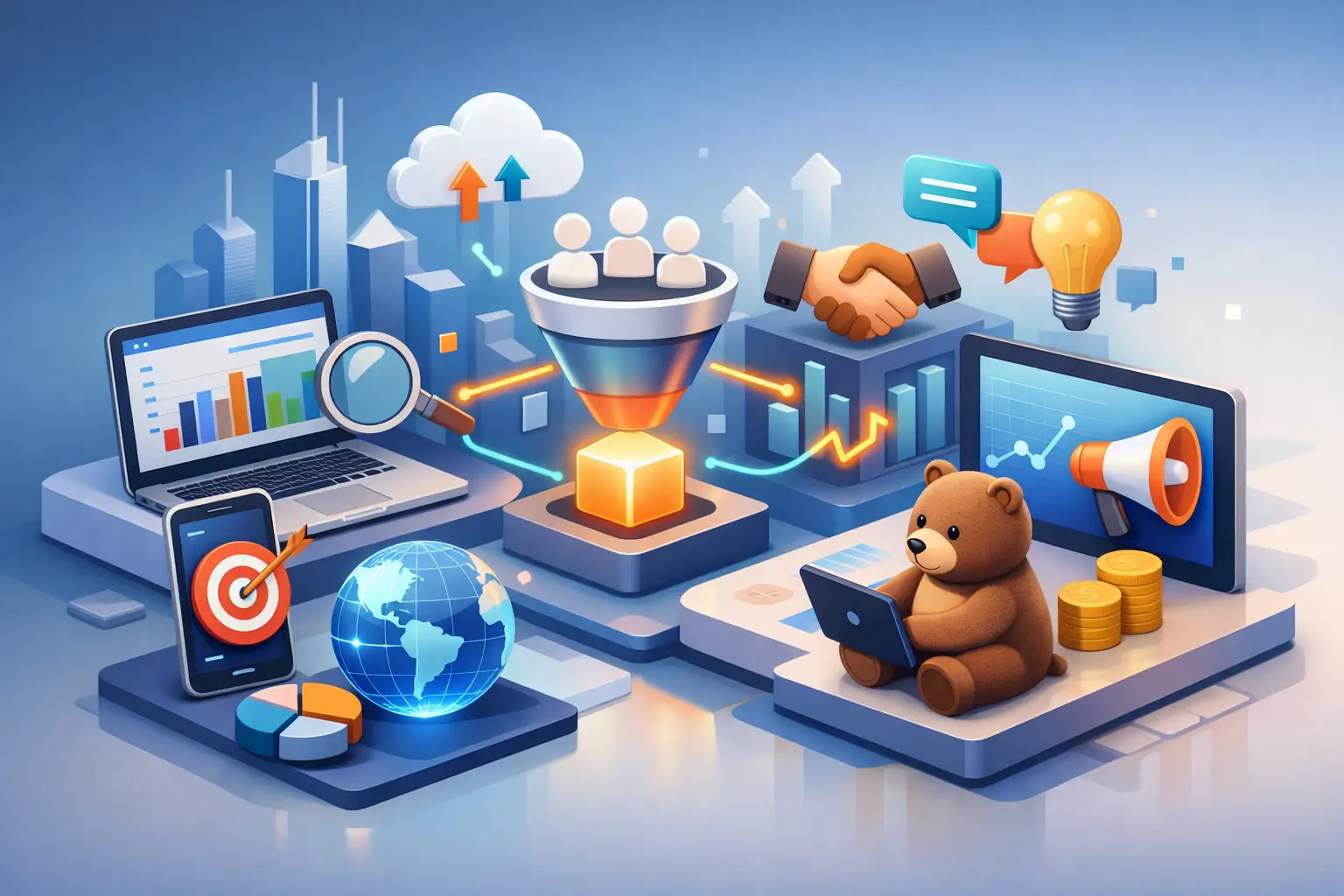
Digital Marketing Strategy for B2B in 2026
Build a digital marketing strategy for B2B in 2026 that drives leads, sharpens positioning, improves data, and turns tech into growth.
Most B2B companies are not losing because they lack effort. They are losing because their marketing stack, website, data, and campaigns were built for a slower market. A real digital marketing strategy for B2B in 2026 has to do more than generate traffic. It has to connect visibility, credibility, speed, and conversion into one system that produces pipeline.
That shift matters because buyers are harder to impress and easier to lose. They self-educate longer, compare more vendors, and expect every digital touchpoint to feel clear and credible. If your site is outdated, your tracking is weak, your ad strategy is fragmented, or your follow-up is slow, the market notices. In 2026, good marketing is not a set of channels. It is a growth engine.
What a digital marketing strategy for B2B in 2026 really requires
The old playbook treated SEO, paid ads, email, content, and web development like separate departments. That model creates drag. One team brings traffic, another owns the website, someone else manages CRM workflows, and nobody is accountable for how those parts affect revenue together.
The better model is integrated. Your website should be built for performance, not just appearance. Your ad campaigns should inform your content strategy. Your CRM should show which channels bring qualified opportunities, not just form fills. Your automation should help sales move faster, not send generic sequences that get ignored.
This is where many B2B businesses stall. They invest in tactics without fixing the operating system underneath them. More traffic will not solve a weak offer. More ad spend will not fix slow landing pages. More content will not rescue poor positioning. Strategy starts with alignment.
The market is rewarding clarity, not volume
In 2026, B2B buyers are overwhelmed by recycled content and generic claims. Saying you deliver quality, innovation, or personalized service is not enough. Every competitor says that. The brands gaining ground are the ones that make their value obvious fast.
That means your positioning has to be tighter. Who do you serve best? What problem do you solve better than alternatives? Why should a buyer trust you now? If your homepage, ads, and sales materials answer those questions differently, your marketing will feel inconsistent even if the creative looks polished.
Clarity also improves performance across channels. Search campaigns get more efficient when the offer is specific. Organic content performs better when it targets real buying questions instead of broad traffic terms. Sales conversations improve when leads arrive with the right expectations.
Your website is no longer a brochure
For most B2B companies, the website is the center of the entire strategy. It shapes first impressions, supports search visibility, qualifies traffic, and converts interest into action. In 2026, that job is too important for a slow, hard-to-update site that was built around aesthetics alone.
A strong B2B site should load fast, explain value quickly, support content, integrate with your CRM, and make conversion paths obvious. It should also be flexible enough to support campaign landing pages, new offers, and technical improvements without forcing a rebuild every time the strategy evolves.
This is where the technology side becomes a competitive advantage. Modern frameworks, cleaner data structures, better CMS choices, and stronger analytics implementation are not just development decisions. They affect rankings, user behavior, lead quality, and marketing speed. Companies that treat web technology as part of growth strategy will move faster than companies still managing digital with patchwork tools.
Paid media still works, but lazy targeting does not
Paid search, paid social, and retargeting remain valuable in B2B. What changed is the tolerance for waste. If your targeting is broad, your messaging is generic, and your landing pages are weak, paid media becomes expensive very quickly.
The smarter approach is tighter segmentation. Different industries, deal sizes, and buyer roles often need different messaging. A CFO, operations leader, and founder may all influence the same purchase, but they do not care about the same proof points. Your campaigns should reflect that.
Measurement matters just as much. Looking only at cost per lead can mislead you. Some campaigns produce cheap leads that never close. Others bring fewer leads but better-fit opportunities. In 2026, B2B paid strategy needs to connect spend to pipeline quality, sales velocity, and revenue contribution.
SEO in 2026 is about authority you can prove
Search is still one of the strongest long-term channels for B2B, but the bar is higher. Thin articles written to fill a calendar will not carry a serious SEO program. Search engines and buyers both reward expertise, structure, and usefulness.
That means content should support commercial intent. Not every article needs to sell directly, but it should strengthen trust, answer meaningful questions, and move the buyer closer to action. Pages built around services, industries, use cases, and comparison topics tend to matter more than high-volume vanity content.
Technical SEO also deserves more attention than many B2B firms give it. Crawlability, site architecture, page speed, schema, and clean internal content structures all influence how efficiently your site can compete. If your site foundation is weak, content alone will not carry the load.
Automation and AI should improve execution, not create noise
AI is changing B2B marketing fast, but not always for the better. Many teams are using it to publish more content, write more emails, and build more assets without improving quality. That adds noise. It does not add advantage.
The real opportunity is using AI and automation where speed and consistency create business value. That can mean faster reporting, lead routing, smarter segmentation, CRM enrichment, campaign testing, sales enablement, or content production workflows guided by strong human strategy.
There is a trade-off here. Automation can save time, but too much automation can flatten your message and weaken trust. B2B decisions often involve high stakes, long cycles, and multiple stakeholders. Buyers can tell when communication feels templated. The goal is not to remove the human layer. The goal is to make your team sharper.
Data quality is now a strategic issue
A surprising number of B2B companies still make marketing decisions with incomplete attribution, poor CRM hygiene, and disconnected reporting. That leads to bad budget decisions. It also creates tension between marketing and sales because nobody agrees on what is actually working.
A better digital marketing strategy for B2B in 2026 depends on cleaner data. You need visibility into source quality, campaign influence, conversion paths, and sales outcomes. You also need agreed definitions. What counts as a qualified lead? When does a marketing lead become a sales opportunity? Which channels assist revenue even when they are not the final touch?
Perfect attribution is unrealistic. Better attribution is not. The goal is to make decisions with enough confidence to scale what works and cut what does not.
Why integration beats outsourcing by channel
Many businesses still hire one vendor for web design, another for ads, a freelancer for SEO, and an internal person to coordinate the mess. That setup can work, but it often slows everything down. Strategy gets fragmented, reporting becomes inconsistent, and execution loses momentum.
An integrated partner can usually move faster because strategy, design, development, advertising, and analytics inform each other. If a landing page is underperforming, the ad team and web team can solve it together. If SEO reveals a strong buyer theme, content and paid campaigns can align around it. That kind of coordination is hard to fake.
For growth-focused B2B companies, this is often the difference between marketing that looks active and marketing that actually compounds.
What to prioritize first
If your current marketing feels scattered, start with the pieces that affect everything else. Tighten your positioning. Fix your website foundation. Clean up measurement. Then build channel strategy around real business goals, not activity for activity's sake.
That may mean doing less for a quarter while you rebuild the core. For some companies, that is the right move. For others, especially firms that need lead flow now, the better path is to improve the foundation while keeping high-intent channels running. It depends on budget, sales capacity, and how broken the current system really is.
What should be clear by now is this: 2026 will reward B2B companies that treat digital as infrastructure, not decoration. The firms that win will pair sharp positioning with better technology, tighter execution, and cleaner data.
If that is the direction you want to take, BearSolutions can help you build a system that connects web, marketing, advertising, AI, and automation around one goal - growth. Request a call and let’s look at where your current strategy is leaking revenue and where the next gains are hiding.
The companies that dominate online next year will not be the loudest. They will be the ones that are easiest to trust, easiest to find, and easiest to buy from.