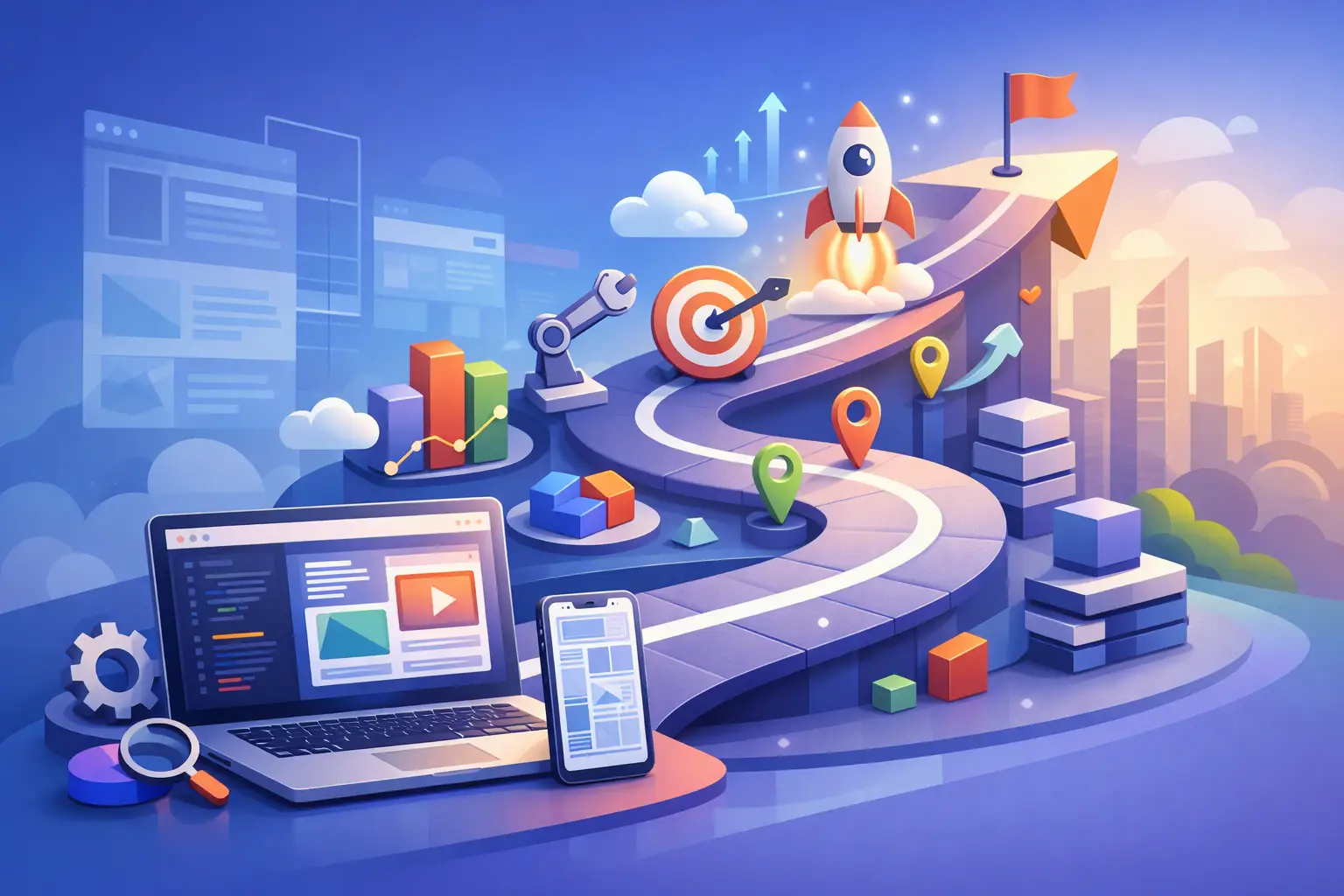
Web Development 2026 Roadmap for Growth
Use this web development 2026 roadmap to plan faster sites, smarter stacks, and stronger lead generation for measurable business growth.
Most businesses do not lose online because they lack effort. They lose because their website stack, content flow, and lead capture process were built for a different internet. A smart web development 2026 roadmap is not about chasing trends. It is about building a faster, more flexible digital system that helps your business rank, convert, and scale.
For small to mid-sized companies, the stakes are simple. Your website is no longer a brochure. It is your sales floor, lead funnel, brand proof, and data source at the same time. If it is slow, hard to update, disconnected from marketing, or impossible to measure, it will hold back growth no matter how good your service is.
What the web development 2026 roadmap actually means
A real roadmap is not a list of shiny tools. It is a business plan for your digital foundation. It answers a few direct questions. Can your site load fast on every device? Can your team publish and update content without breaking pages? Can your site support SEO, paid traffic, automation, and analytics without turning into a maintenance problem?
That is the shift happening now. In 2026, winning websites will be built as performance assets, not one-off design projects. The companies that move first will have a clear edge because they will launch faster, test faster, and adapt faster.
The stack is becoming more strategic
For years, many businesses chose websites based on what looked easiest upfront. That often led to bloated themes, plugin overload, and fragile setups that became expensive later. The next phase of web development is more intentional.
Modern frameworks like Next.js are gaining ground because they support speed, flexibility, and stronger technical SEO. Headless content systems such as Payload are appealing because they separate content from presentation, which gives businesses more control over how content is delivered across pages, campaigns, and future platforms. Tools like Framer can also make sense in the right context, especially when speed to market and visual polish matter.
But the right stack depends on the business model. A service company focused on lead generation needs a different setup than a SaaS product or an ecommerce operation. The roadmap is not about adopting advanced technology for its own sake. It is about choosing technology that supports growth without creating technical debt.
Speed and UX are now revenue issues
In 2026, performance will keep separating strong brands from weak ones. Site speed affects search visibility, ad efficiency, bounce rate, and form completion. User experience affects trust. Those two factors now work together.
This means development decisions need to be commercial decisions. Heavy animations, oversized media, and cluttered interfaces may look impressive in a review meeting, but they often hurt conversion once real traffic hits the site. Clean builds, optimized images, smart caching, and lean front-end architecture create better business outcomes.
There is a trade-off here. Premium interactions and motion can absolutely strengthen a brand when used with discipline. The problem starts when design becomes decoration instead of direction. Strong web development in 2026 will balance visual quality with speed, clarity, and usability.
Content systems need to support marketing, not slow it down
One of the biggest hidden costs in web development is content friction. If your team needs a developer every time they want to add a landing page, publish an article, update a service section, or test a lead magnet, your site is not built for growth.
The web development 2026 roadmap should include a content model that makes marketing easier. That means reusable components, structured content, and page systems that let teams move quickly without sacrificing consistency. It also means building websites with SEO and campaign expansion in mind from day one.
This is where an integrated partner matters. Web development should not sit in a silo while SEO, ads, and brand messaging operate somewhere else. The strongest results come when design, development, and digital marketing are planned together.
AI will shape workflows more than websites
A lot of companies hear AI and assume the website itself needs a chatbot on every page. Sometimes that helps. Often it does not. The bigger opportunity is behind the scenes.
In 2026, AI will increasingly support content operations, personalization logic, internal search, lead qualification, data analysis, and automation. It can help teams produce more targeted pages, identify conversion bottlenecks, and improve response times. It can also create mess if it is layered onto a weak foundation.
That is the key distinction. AI works best when the website structure, analytics, and content architecture are already strong. If the site is disorganized, AI only accelerates confusion. Businesses should think of AI as an amplifier, not a substitute for strategy.
SEO and development are merging again
For a while, many companies treated SEO as something added after launch. That approach is fading fast. Search performance now depends heavily on development quality.
Technical SEO basics still matter - crawlability, metadata control, internal linking, schema, page speed, and mobile usability. But 2026 will reward sites that also support topical depth, clean content hierarchies, and scalable page creation. If your developers and marketers are not aligned, your rankings will reflect that.
This is especially important for local and regional service businesses competing for high-intent traffic. Your website has to do more than exist. It needs to send strong trust signals, support geo-targeted content, and create clear paths from search to inquiry.
Security, privacy, and reliability are no longer back-office concerns
Customers may never ask what powers your site, but they will notice when something breaks, loads poorly, or feels untrustworthy. As websites become more connected to CRMs, ad platforms, analytics tools, payment systems, and automation flows, reliability becomes a brand issue.
A good roadmap includes hosting strategy, deployment workflows, access control, backup planning, and monitoring. It also includes discipline around third-party scripts. Every extra tool can add value, but it can also add risk, slow down the site, or create reporting problems.
This is another place where businesses need clarity. Convenience can be expensive if it creates long-term instability. A simpler stack, well maintained, often outperforms a larger stack built without guardrails.
What businesses should prioritize now
If you are planning for the next 12 to 24 months, do not start with features. Start with outcomes. Do you need more qualified leads, stronger authority in search, better campaign landing pages, or a site that your team can actually manage without friction?
From there, the roadmap becomes clearer. Many businesses should focus on four practical moves. Rebuild or modernize the site architecture for performance. Create a content system that supports SEO and paid campaigns. Connect analytics and conversion tracking properly. And choose a stack that can grow with the business instead of trapping it in workarounds.
That may mean moving to a modern framework. It may mean replacing a fragile CMS. It may mean tightening your front-end performance or redesigning templates around conversion instead of aesthetics. It depends on where the current bottleneck is.
The companies that win will treat their site like infrastructure
A website project mindset leads to one big launch followed by months of stagnation. A growth mindset treats the website as living infrastructure. It evolves with campaigns, sales goals, customer behavior, and search opportunities.
That is the real advantage of a strong web development roadmap. It does not just give you a better website. It gives you a better operating system for online growth.
For businesses that want to dominate online, 2026 is the right time to stop patching old systems and start building with intent. The best websites will not be the ones with the most features. They will be the ones built to move the business forward, month after month, with speed, clarity, and measurable impact.
If your current site cannot support that kind of momentum, that is not a small issue. It is your next growth decision.