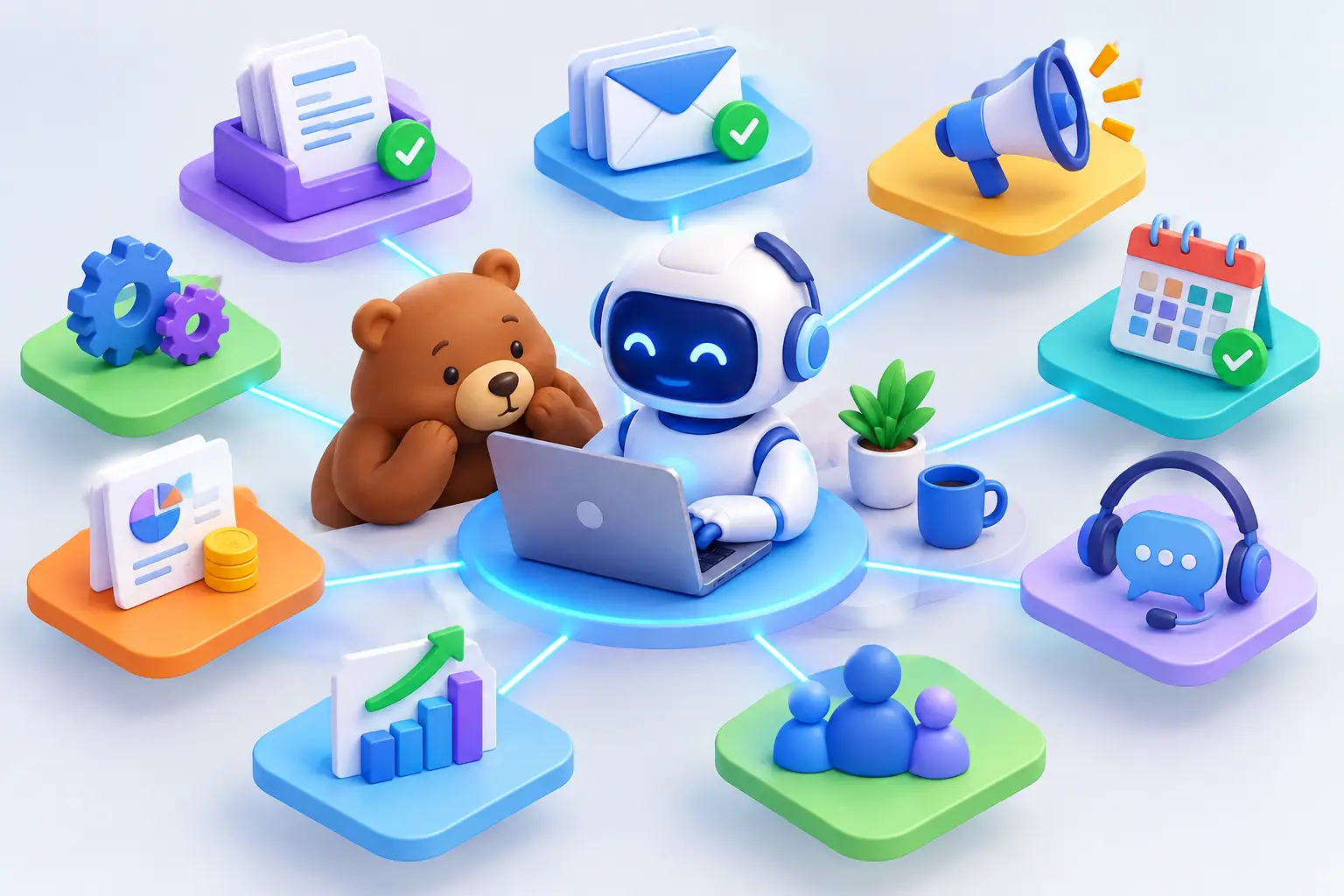
8 Business Processes You Can Automate With AI Right Now
See 8 business processes you can automate with AI right now to cut manual work, respond faster, and put your team’s time toward growth with less friction.
A lead fills out your website form at 9:14 p.m. By the next morning, they have already heard from a competitor. That is the cost of slow, manual operations. The 8 business processes you can automate with AI right now are not futuristic experiments. They are practical ways to respond faster, reduce repetitive work, and keep revenue-moving tasks from falling through the cracks.
For small and mid-sized businesses, AI automation is not about replacing a good team. It is about giving that team fewer busywork bottlenecks and more time to sell, serve customers, and make smarter decisions. The strongest results come from automating repeatable work with clear inputs, clear outcomes, and human review where judgment matters.
8 Business Processes You Can Automate With AI Right Now
1. Lead capture, qualification, and routing
Every new inquiry deserves a fast response, but not every inquiry deserves the same sales process. AI can read form submissions, chat conversations, email inquiries, and CRM data to identify what a prospect needs, how urgent the request is, and where that lead should go next.
A roofing company, for example, can automatically separate storm-damage requests from general estimate inquiries. A B2B service company can flag high-value prospects based on company size, stated budget, location, or requested service. The system can then create a CRM record, assign an owner, send a tailored first response, and alert the sales team when a lead meets priority criteria.
The trade-off is simple: automation is only as good as the routing rules behind it. Start with a small number of qualification signals, then refine them based on closed-won and closed-lost data.
2. Customer service triage and follow-up
Customers do not care whether a request arrives through email, a website chat, social media, or a contact form. They care about getting a useful answer quickly. AI can classify incoming messages, draft replies from approved knowledge, identify urgent issues, and route complex cases to the right person.
This works especially well for common questions about scheduling, pricing ranges, order status, service areas, onboarding steps, or required documents. It can also trigger follow-up messages after a support ticket is resolved, helping you catch problems before they become negative reviews or lost accounts.
Do not hand AI full control of sensitive complaints, refunds, legal questions, or technical issues with real consequences. Those need escalation paths and trained people. Use AI to speed up the first layer of service, not to hide your business from customers.
3. Sales follow-up and proposal preparation
A missed follow-up can cost far more than an ad campaign that underperformed. AI can create reminders, summarize sales calls, write follow-up emails, and suggest next steps based on the conversation. When connected to your CRM, it can spot leads that have gone cold and prompt your team before momentum disappears.
Proposal preparation is another high-impact opportunity. AI can pull approved service descriptions, relevant case points, scope details, and pricing frameworks into a first draft. Your sales team still controls the strategy, numbers, and final promise, but they are no longer building every proposal from a blank page.
This is where speed creates a competitive edge. The business that responds with a clear, tailored proposal while the prospect is still engaged often wins the conversation.
4. Marketing content production and repurposing
Marketing teams lose hours turning one strong idea into a blog post, email, social caption, ad variation, sales script, and landing page update. AI can accelerate that production cycle by creating structured first drafts and adapting a message for different channels.
The key phrase is first draft. Generic AI copy will not make a business memorable, and it will not fix a weak offer. But when your team provides real customer insights, sales objections, product details, and a defined brand voice, AI can help produce more useful content at a much faster pace.
For local businesses, it can also help organize location-specific messaging without creating thin, repetitive pages. Every piece still needs an editorial standard: accurate claims, clear positioning, and a reason for the audience to act.
5. Paid advertising optimization and reporting
Ad platforms generate more data than most owners have time to interpret. AI can organize campaign performance, detect unusual shifts in cost per lead, identify creative fatigue, summarize results, and prepare regular reports in plain language.
It can also help generate ad copy variations, audience hypotheses, and landing page tests. That does not mean you should let a system spend freely without oversight. Automated bidding and AI-generated recommendations can waste money when conversion tracking is wrong or when the platform is optimizing for low-quality leads.
The better approach is to automate the analysis and recurring reporting, then keep strategic decisions tied to business outcomes. Leads, booked appointments, qualified opportunities, and revenue matter more than clicks alone.
6. Invoice processing and payment reminders
Manual invoice work is repetitive, time-consuming, and easy to delay when the team gets busy. AI can extract data from invoices, categorize expenses, match purchase orders, flag duplicate charges, and move documents through an approval workflow.
On the accounts receivable side, it can send polite payment reminders based on due dates, payment history, and account status. It can also alert your team when a client needs personal outreach rather than another automated message.
Financial automation requires tighter controls than marketing automation. Set approval thresholds, protect access to financial systems, and make sure a person reviews exceptions. The goal is fewer administrative delays, not blind financial decisions.
7. Recruiting, onboarding, and internal knowledge access
Hiring and onboarding often break down because information lives across email threads, shared drives, spreadsheets, and people’s heads. AI can screen applications against defined role requirements, schedule interviews, summarize candidate responses, and prepare onboarding checklists for new hires.
Internally, an AI knowledge assistant can help employees find current policies, process documents, project templates, and training materials without asking the same questions repeatedly. This is particularly valuable for growing businesses where experienced staff are constantly interrupted for routine answers.
Keep hiring decisions human. AI can reduce administrative load and create consistency, but it should not be the sole judge of a candidate’s fit, character, or potential.
8. Operations reporting and forecasting
Most businesses have the data to make better decisions. It is just scattered across accounting software, CRMs, spreadsheets, ad platforms, project tools, and e-commerce systems. AI can consolidate those sources, create recurring performance summaries, spot trends, and forecast demand based on historical patterns.
A service business may use this to predict staffing needs. A retailer may use it to anticipate inventory demand. A marketing team may use it to connect campaign performance to lead quality and sales outcomes. Instead of waiting until the end of the month to see what happened, leaders can get a clearer view while there is still time to act.
Forecasting is not certainty. Seasonality, market changes, promotions, and incomplete data can distort predictions. Treat the output as a decision tool, not a guarantee.
Build the System Before You Add More Tools
The temptation is to buy an AI tool for every department. That usually creates another disconnected stack, more logins, and more confusion. Start with one process that is repetitive, measurable, and currently slowing down revenue or customer service.
Map the process from trigger to outcome. Define what information the automation needs, what action it should take, what exceptions require a person, and how you will measure success. Response time, conversion rate, hours saved, error rate, and customer satisfaction are better metrics than simply counting automations.
BearSolutions Marketing & Technology helps businesses connect websites, marketing, advertising, data, and automation into systems built for growth. If you want to know which AI workflows fit your operation, what implementation could look like, or what it may cost, request a call with our team.
The best place to start is rarely the flashiest use case. Start where a customer is waiting, a salesperson is chasing information, or a skilled employee is stuck doing work a system can handle. Fix that bottleneck well, and the next opportunity becomes much easier to see.